Today I had the opportunity to visit significant archeological sites and a wonderful museum in northern Peru, near Chiclayo, about 500 miles north of Lima. After reading books about this remarkable find I was able to see objects of metalwork, ceramics, shell beadwork and more of the Moche civilization. One of several ancient cultures, the Moche thrived around 100-850 a.d.

Little was known about this people until 1987, when archeologists uncovered ancient burials close to the village of Sipán. The site is called Huaca Rajada. A huaca is a ceremonial mound of mud bricks, and they are found in many parts of coastal Peru. At first glance, the huaca looks like a giant glob of melting ice cream.

But on closer examination, you can occasionally see the adobe bricks that were used in the construction hundreds of years ago.

Sipán is an agricultural region southeast of Chiclayo. Principal crops are sugar cane, rice and beans. Ample water flows from the nearby Andes mountains, creating favorable conditions for people to live in the valleys along the rivers. Several civilizations have thrived here for 5,000 years or more.


Though looters had invaded much of the area, this tomb was discovered intact in 1987. It has been excavated and studied by archeologists, who found that succeeding civilizations had used the same burial huaca for centuries. Each group buried their elite rulers on top of the previous group. Excavation took years to complete, and many objects of gold, silver and copper were cleaned and placed in a museum in Lambayeque, north of Chiclayo. Replicas of the contents of the tomb can be seen here.

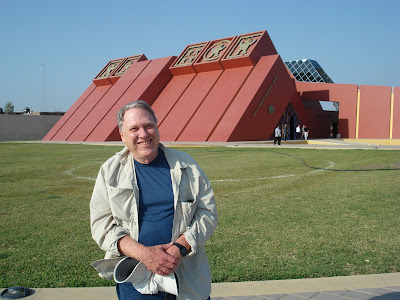
This is the museum of the royal tombs, Museo de las Tumbas Reales, in the town of Lambayeque. It was completed in 2002. The displays are placed on levels corresponding to their location in the tomb, so one begins from the top to view the most recent burials. The oldest objects are at the street level. It is possible that more burials are still below the latest excavations in the huaca.
 We rode along a dusty road that passes by corn fields, sugar cane, and adobe huts. Mango trees and papaya were seen near the homes.

 The forest is a protected area of 15,000 acres, covered in dry algarrobo (carob) trees and containing huacas (adobe structures) dating from the middle Sicán period (900-1100 ad). Some have been covered with later Chimú burials.
 This next huaca is 50 meters (164 feet) high. It must have been much larger originally. As with all huacas, it is built entirely of adobe bricks.
 The huacas have been studied but not excavated. Manuel and I speculated on how much gold might be under this pile of dried mud. As with most huacas, rain and wind have carried away much of the original material. Up close the shapes of adobe bricks become apparent.
 On the ride back to the ranch we see a well and equipment for making the adobe bricks. Little has changed in construction materials in the past two thousand years.
 Heading back to the ranch, we run into a traffic jam on the trail. Some people are working on the irrigation supply, and we must wait 20 minutes until they finish covering the large flexible pipe carrying water just under the road. Ahead of us is a donkey cart with firewood. No one is in a hurry. My chestnut horse was the only impatient one on the road.