Showing posts with label Chiloé. Show all posts

Monday, March 24, 2025

Achao 2025


Click on any photo to enlarge.


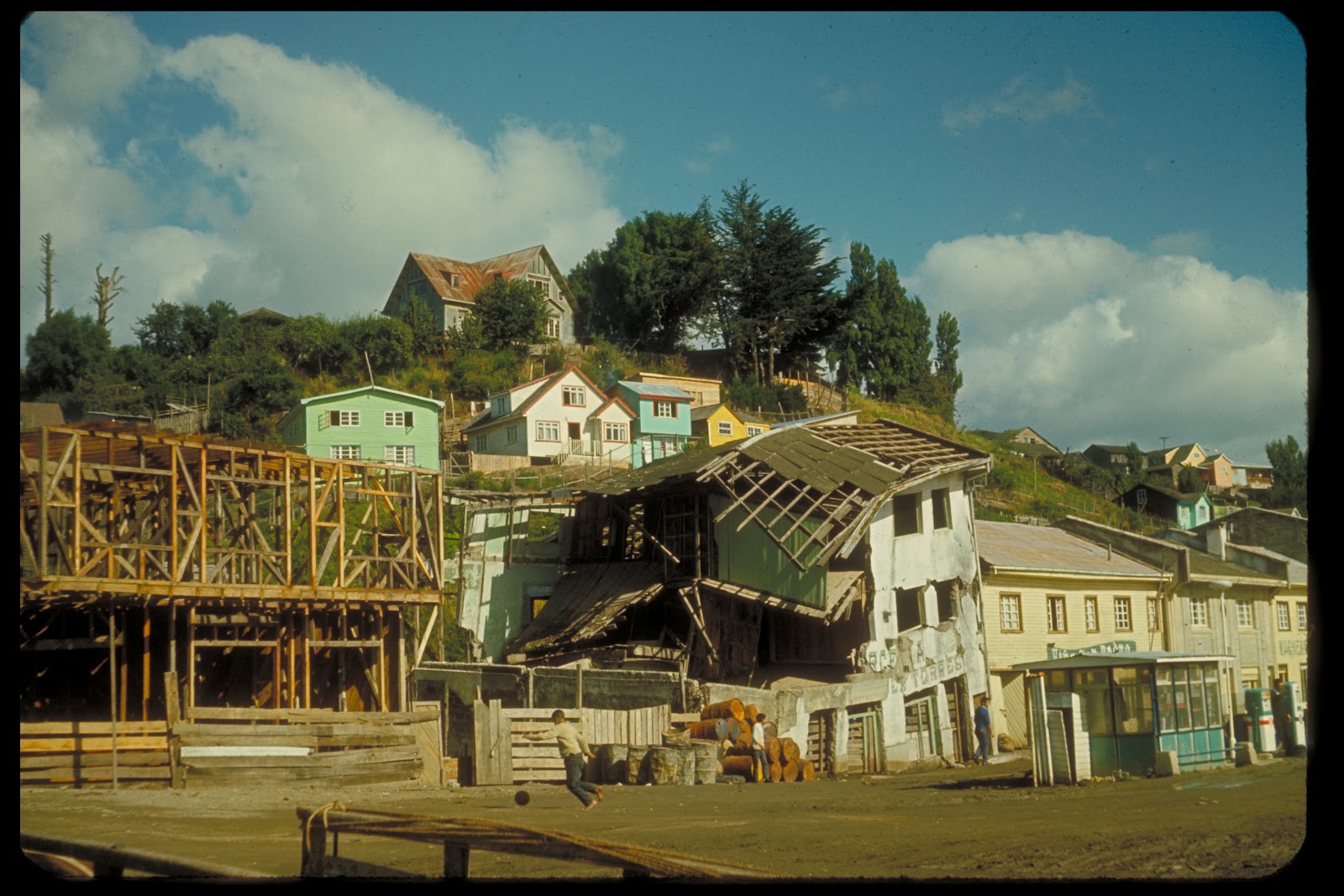
Achao 1965


Achao 2025


60 years ago, I visited the village of Achao on Quinchao Island in Chile. As I wandered about, I met a group of children playing and they cautiously agreed to pose for a photo, never having seen a camera or a tall gringo. 

Hace 60 años, fuí al pueblo de Achao en la isla Quinchao en Chile. Mientras andaba arriba del pueblo, encontré un grupo de niños jugando, Como nunca habían visto una máquina fotográfica ni un gringo, ellos cautelosamente estuvieron de acuerdo a posar para una foto,


In 2017, Javier Mansilla created the scene in an oil painting.
El pintor puertomontino Javier Mansilla recreó la escena en 2017


On March 6 2025, my friend Patricio Alarcón of Turismo Quehui kindly offered to take Javier and me to Isla Quinchao. We visited the museum in Curaco de Vélez, and then continued on to Achao, where we visited the historic church in Achao and the local museum. Javier had come here in recent years to track down the children in the photo, and had one contact in his FaceBook, the girl in the red dress. We called her phone and she enthusiastically invited us to visit her home, only a few blocks from where we were having lunch.

El día 6 de marzo de 2025, el amigo Patricio Alarcón de Turismo Quehui amablemente se ofreció a llevarnos a la isla Quinchao. Pasamos por el museo en Curaco de Vélez, y después seguimos rumbo a Achao, donde pasamos a la histórica iglesia y al museo regional. Javier había venido aquí en años recientes, buscando rastros de los niños de la foto, y tenía un contacto en su FaceBook, la niña de vestido rojo. La llamamos por teléfono y ella nos invitó con entusiasmo a su casa, apenas cuadras de donde almorzamos.


A reunion with the girl in the red dress was a happy event for all uf us. Gisela still lives in Achao with her husband. She served us tea and homemade bread and jam. Here is a short video of our visit.

Una reunión con la niña de vestido rojo fue un evento feliz para todos. Gisela aún vive en Achao con su marido. Nos sirvieron té y pan amasado con mermelada hecha en casa. Aquí está un corto video de la visita.

Roger, Gisela, and Javier


Achao 1965

Click on any photo to enlarge.

View of Achao on February 7, 1965 from the Cessna 4-seat airplane, traveling from Puerto Montt to the island of Chiiloé, Chile.

Vista aérea de Achao el 7 de febrero, 1965 desde el Cessna de 4 plazos, viajando de Puerto Montt a la isla de Chiloé, Chile.

It was a Friday morning, February 12, 1965 in Castro on the island of Chiloé, where I boarded a small, rural bus that took us to the town of Dalcahue. At the boat landing a small motor launch was waiting to take passengers across the narrow channel, a crossing of five or ten minutes to Quinchao Island. Another rural bus was waiting at the other side. Passing through gently rolling fields and small towns, we arrived at the end of the road in Achao, a village nestled in the green hills at the edge of the sea. All construction in the area is of local wood.

Un día viernes, 12 de febrero de 1965, desde Castro, en la isla grande de Chiloé, tomé una micro a Dalcahue. En la rampa frente el canal, nos esperaba una lancha a motor para cruzar el canal, que demora unos cinco o diez minutos para llegar a la Isla Quinchao. Bajando de la lancha al otro lado del canal, esperaba otra micro y subimos. Pasamos por el lindo paisaje de predios verdes entre pequeños pueblos. Al final del recorrido, nos encontramos en Achao, una pequeña aldea pintoresca encalada entre colinas verdes ubicada a la orilla del mar. Toda construcción en la zona es de madera.


It appears that the locals have not seen many tourists, especially a foreign-looking one, and curious eyes follow me everywhere. Women do not wear shoes, and most carry a black woolen shawl which they use to cover their head when it rains. I struck up a conversation with a farmer from a neighboring island. He tells me that the several surrounding islands are populated and cultivated. They produce their own necessities and a little to sell, but that the price of potatoes is low.


Parece que los lugareños no habían visto muchos turistas, ni menos un gringo norteamericano, y hay ojos que me persiguen dondequiera que vaya. Mujeres del pueblo andan descalzadas, la mayoría con un chal de lana negra, con que se cubre la cabeza cuando llueva. Me encontré con un vecino y nos pusimos a conversar. Me contó que reside en una isla cercana y que todas las islas del archipiélago están pobladas y cultivadas. Producen lo que necesitan para su familia y un poco para vender, aunque el precio de papas es muy bajo.


Walking along the dirt and gravel streets, I found the main plaza and a large, ancient church. It is the oldest church in Chile and was built by the Jesuits beginning in 1730. It looks in poor condition and in need of restoration. Inside, the ceiling is painted blue and white with ornate decorative wood carvings. An old altar remains, but a new one is installed that allows the priest to face the congregation according the recent decision of the Second Vatican Council.


Andaba por las calles de ripio y tierra, y frente la plaza de armas encontré una linda iglesia, la más antigua de Chile. Construida por los jesuitas a partir de 1730, se veía en mala condición y reclamaba por restauración. El techo adentro está pintado en azul y blanco, con decoración adornada de madera. El altar antiguo queda, pero uno nuevo se instaló según el Concilio Vaticano II, para que el sacerdote esté de cara a la congregación.


There are no restaurants in Achao, but I found a rooming house which offered lunch, a delicious mutton stew, about the only thing served in the region apart from fish and potatoes.


No hay restaurantes en Achao, pero encontré un hospedaje que me sirvió un almuerzo, una rica cazuela de cordero, casi lo único que se come acá aparte de pescado y papas.


The main mode of transportation on land is by horse and ox cart, although there were a few pickup trucks in town. A single-mast sloop, unique to the region, carries produce, people and animals between the islands. I watch as firewood is unloaded on to an oxcart on the beach. Another arrived recently with a flock of sheep which were delivered to the small wharf.


El principal modo de movilizarse en tierra es por caballo y carreta, aunque se veían algunas camionetas. Lanchas a vela llevan productos, personas y animales entre las islas. Veo una lancha descargando leña de una carreta de bueyes en la playa, y otra que recién llegó con un rebaño de ovejas, descargando por el pequeño muelle. 


It rained intermittingly all day, with some sun, which allowed me to wander around the town and up into the surrounding hills to get some good views of the town and the surrounding islands. There was a hazy view of the snow-covered Andes mountains in the distance. Walking up one hill, I encountered a group of eight children playing, all in their bare feet. They had two small wooden carts used for carrying firewood, and were enjoying playing in the open fields. They looked at me with great curiosity and wonder, and probably without ever having seen a camera or a tall gringo. Somehow, I convinced them to pose for a photo. The photo has become one of my favorites of the trip. I returned to the village several times since then, but in 2025 I met the little girl in the red dress. That story is in my next blog post.


Llovía a ratos por todo el día, con poco sol, lo que me permitía andar por el pueblo y más arriba en los cerros para disfrutar de una vista panorámica del pueblo y las cercanas islas. Apenas se veía la cordillera de los Andes con nieve en la distancia. Caminando por un cerro, me acercaran unos ocho niños jugando, todos a pata pelada. Tenían dos carretas para llevar leña que les servían de juguetes. Me miraban con caras de curiosidad y medio miedo, sin haber visto una cámara fotográfica ni un gringo alto andando solo por el campo. Les convencí a posar para una foto, que ha sido una foto preferida de mi viaje. Volví varias veces al pueblo tras los años, pero en 2025 conocí la niña de vestido rojo. Ese cuento aparece en el próximo post.


I returned to Castro for dinner of mutton stew. I lost seven escudos in the card game that evening.


Volví a Castro para una cena de cordero. Perdí siete escudos en un juego de cartas esa tarde.


Friday, March 14, 2014

Chepu, Chiloé, Chile


Home sweet home. This is just about my favorite destination in Chile, “Los Senderos de Chepu,” on the big island of Chiloé. It is by far the best-equipped B&B in Chepu to visit for a few hours or for several days, which is always my choice. The attraction is a gorgeous location in a quiet setting surrounded by gardens, pastures, forest, river and ocean. Rooms are comfortable and with modern conveniences. Outdoor activities abound, including fishing, hiking, horseback riding, visiting penguins, or my favorite, relaxation.


The beautiful garden is full of color year around


Chepu is not a village, but an area located a few miles southeast of Ancud on the island of Chiloé. Several families live here, spread over many miles. There is a bus that serves the area three times per week.


Country church


The locals have modern conveniences and vehicles, but the ox cart is most practical for transporting items on the farm, especially firewood that is needed daily.


The grass is always greener on the other side. I watched as this cow carefully removed his head from the barbed wire.


“Reduce, Recycle, Reuse”


Comanche and Mariachi


In the dunes; Chepu River is in the background


We must cross some wetlands to get to the beach


Don Fernando, my host and guide. Across the river to the south is the Chiloé National Park, on the west coast of the island.


This is our destination, Elephant Rock


Pacific Ocean at Aulen Beach


Lichens at the beach


View from above, near the main house, looking south toward Chiloé National Park


In the forest, I set off on a muddy path down to the river, about 30 minutes away. I brought rubber boots two years ago and leave them at the main house. It’s all I use outdoors. 


Ferns in the forest


The trail ends at the river. Many trees died in 1960 when southern Chile was hit with the largest earthquake ever recorded (Richter 9.5) The epicenter was near Valdivia to the north, but the land in many areas sank several feet, causing the river to widen, drowning trees. This is a great area for fishing and bird watching.


My wonderful hosts during many visits to Chepu in a photo from 2012: Señora Enriqueta, Don Fernando and daughter Vanesa, who is almost finished with her medical studies.


Saturday, June 22, 2013

Happy New Year


To celebrate the 2013 winter solstice in the southern hemisphere, during June 21 to 24, the Huilliche (southern Mapuche) community of Chiloé will celebrate Wetripantu or Wechipantu (“New Sunrise” in the Mapudungun language), the Mapuche new year. The community has planned a series of activities over several days, visiting schools, organizing tree plantings, and presenting ceremonies in various locations on the big island of Chiloé and some neighboring islands in the archipelago, comprising an area of about 3,500 square miles.


Chile is a long and narrow country that hugs the impressive Andes mountain chain that marks the border with Argentina in the southern cone of South America. The map above indicates the island of Chiloé, separated from the mainland by a 20-minute ferry ride on the northern tip of the island.
Out of about 17 million inhabitants of Chile, about one million are Mapundungan speakers, members of the Mapuche ethnic group. The southern Mapuche refer to themselves as Huilliche (or Huiliche or Veliche). Fewer than 200,000 people live on Chiloé.


The Mapuche flag 

In March 1991, the Chilean Mapuche organization Aukiñ Wallmapu Ngulam ("Council of All Lands")  made a call to submit designs for a flag of the Mapuche nation. About 500 designs were submitted, of which a one was selected for the Mapuche nation. The flag is called Wenufoye (“The Heaven's Cinnamon” in the Mapudungun language). 
The yellow disk is a symbol for the sun, representing renewal. It also represents the cultrun, or cermonial drum. 
Blue (kallfü) represents life, order, wealth and the universe. In Mapudungun, is also an adjective that could be translated as "sacred" or "spiritual".
White (lüq): the cleansing, healing and longevity symbol of wisdom and prosperity
Red (kelü): strength and power, symbol of history.
Green (karü): the earth or nature, wisdom, fertility and healing power, symbol of the machi (Mapuche shaman).


Friday, September 14, 2012

Castro, Chiloé, photo exhibit Aug 2012


An exhibit of color photographs from 1965,
taken by a casual tourist on the big island of Chiloé, Aysén and Magallanes. 

Color film in that era was scarce and expensive. I had the honor of a faculty position at the Music Conservatory of the Austral University in Valdivia, Chile. Some friends invited me on a trip to the island of Chiloé in January 1965. The journey included travel in a small Cessna airplane from Puerto Montt to Castro, Chiloé. While on the island, I visited Castro, Ancud, Achao, and Chonchi. From there, a small cargo ship delivered me to Puerto Aysén. The only exit from Coyhaique was a DC-3 which flew south to Punta Arenas, on the Straits of Magellan. From there I returned north to Puerto Montt for a visit to the fish market at Angelmó, before returning to my home in Valdivia.

Typical transport of the time

This project of showing 30 photos from the collection was supported by the I. Municipalidad de Castro and Banco del Estado. The photos were prepared and mounted by Javier Areneda. I am indebted to  Felipe Montiel, historian, author, and Director of the Regional Museum of Castro, for his persistence in mounting this project. Many thanks to Juan Carlos Pacheco in coordinating the exhibit.

1960 earthquake damage in Castro

The opening of a new photo exhibit was announced for Friday at 7:00pm. This was my first and probably only event of the kind, so I made the effort to travel to southern Chile in the cold of winter, August 2012. I had no idea what to expect of this event. So, like a typical gringo that I am, I arrived at the appointed time. Social events in Chile typically begin well after the announced hour. To my great surprise, I was the last to arrive, and was welcomed by local and regional government officials, and uniformed representatives of the Carabineros and the Navy. Sergio Colivoro, the leading accordionist of Chiloé, was invited to  perform for the crowd, and dedicated his last song to me. I did three press and radio interviews and found my picture in the Sunday paper of Chiloé, La Estrella. About 100 people attended the opening.

Sergio Colivoro


Recording an interview for the local radio

Children in Achao 1965

The complete collection of 30 photos is available on YouTube.

Click here to go to slide show.

Monday, January 30, 2012

Cucao, Chiloé


 The next stop on my tour of Chiloé island is the small village of Cucao, about 25 miles north of Quellón and on the west coast of the island. This view is from my room at Hostal Palafito Cucao, situated on the bank the Cucao river and looking east at Cucao Lake.


There is excellent cazuela de vacuno (beef and vegetable soup) in the green house across the Cucao River.


The Cucao National Park is a favorite destination for many Chilean and foreign visitors. Many come for the day, and others come to camp or stay in one of the many lodgings available. The above view is the national park trail to the dunes and beach.


The lookout over dunes and beach. This white sand beach is 15 miles long! Charles Darwin stopped by here in the Beagle in 1835. From his journal of January 24:

            “The district of Cucao is the only inhabited part on the whole West coast of Chiloé. It contains about thirty or forty Indians, who are scattered along four or five miles of the shore, and without a single Spanish resident. — They are very much secluded from the rest of Chiloé & have scarcely any sort of commerce, excepting sometimes a little oil which they get from seal blubber. They are pretty well dressed in clothes of their own manufacture, & they have plenty to eat.”


Dunes and beach looking north to Huentemó


Parrots feeding in a tree in the national park.


A short walk inland takes visitors to the tepual, a swampy area covered mostly in tepu trees (tepualia stipularia). A sturdy boardwalk winds through the tepual and many signs help to explain this unique ecosystem.


The tepual


View of Cucao Lake from a lookout in the tepual.


On another day, Patricio (Pato) is my guide to the dunes. I always prefer four sturdy legs under me, rather then my questionable two.

Pato takes me into the hills above the beach and park. This is looking south toward Pirulil.


View of Lake Huelde


Our return to Cucao after about three hours on the trail. In another hour I will take a bus north to the town of Castro, capital of Chiloé.