Thursday, July 4, 2019

Florence and treasures of the Renaissance #2

Santa Croce

This Franciscan church is the burial place of some of the most illustrious Italians. Here are the tombs of Michelangelo, Galileo, Machiavelli, Rossini, and Marconi, inventor of the radio. Works of art by major figures adorn the interior.


The altar of Santa Croce


Standing before the tomb of Gioacchino Rossini


Here is the piazza below my apartment. The apartment is directly above the arch in the center background. A fruit and vegetable stand sets up every morning. The butcher shop is in the building behind, on the right. There are restaurants and bars, and most important, a gelato shop.


For two weeks I crossed this piazza daily and walked five minutes to attend Italian language classes at the ABC Centro di Lingua


On my way to school I passed by this apartment building. It's curved shape indicates that it was an ancient arena.


View of Florence and the Arno River. Santa Croce church is at center right. The Duomo, or cathedral, is to the left, then Giotto's tower and the Baptistry. Far left is the Palazzo Vecchio.


The Duomo and Giotto's Campanile. Construction on the Duomo began in 1296 and lasted until 1436 with the completion of the dome designed by Brunelleschi. The campanile is 278 feet tall and was begun in 1334 when Giotto was 67 years old. 


Side view of the Duomo showing Brunelleschi's dome:


Detail of the marble carving on the façade:


Interior of the Duomo. Note the elaborate paintings of Brunelleschi's dome, and the marble inlaid floor. Otherwise, the is little decoration inside the church.


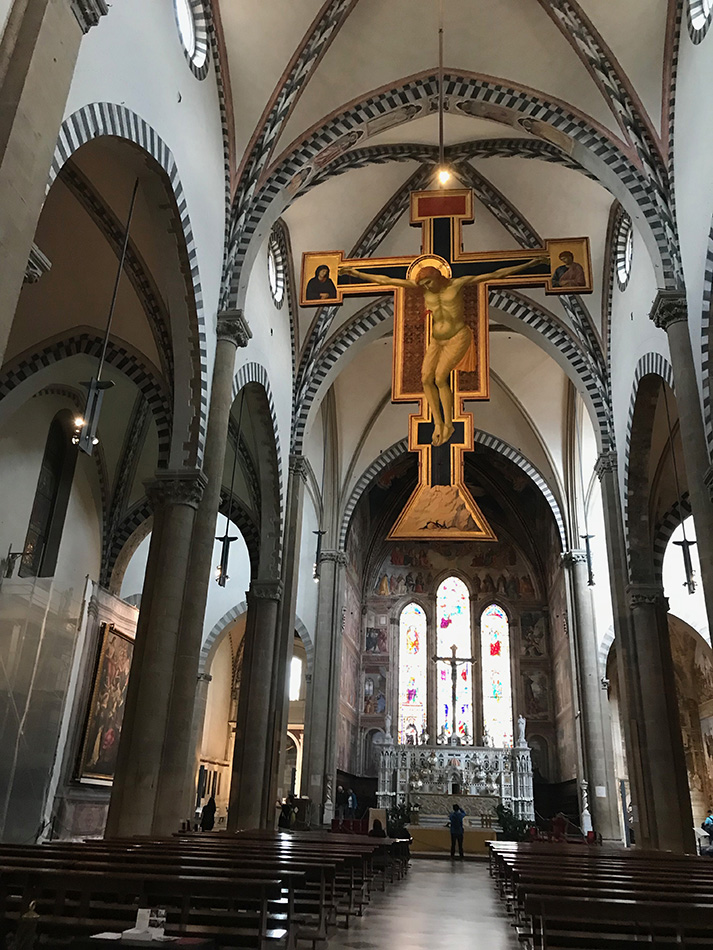
Santa Maria Novella church, with local guide Viviana. The first stone was laid in 1279. The lower part of the façade was decorated in green and white marble in 1350; the upper part was completed in 1470


The crucifix is by Giotto (1267-1337) first appears in documents in 1312, so probably was made at the end of the 1200s, later restored in the 1980s

Fresco by Massaccio (1401-1428), Holy Trinity (1425-26)


Final view of Florence from the Bardini Gardens


Next stop on the Grand Tour: Cremona

Florence and treasures of the Renaissance #1

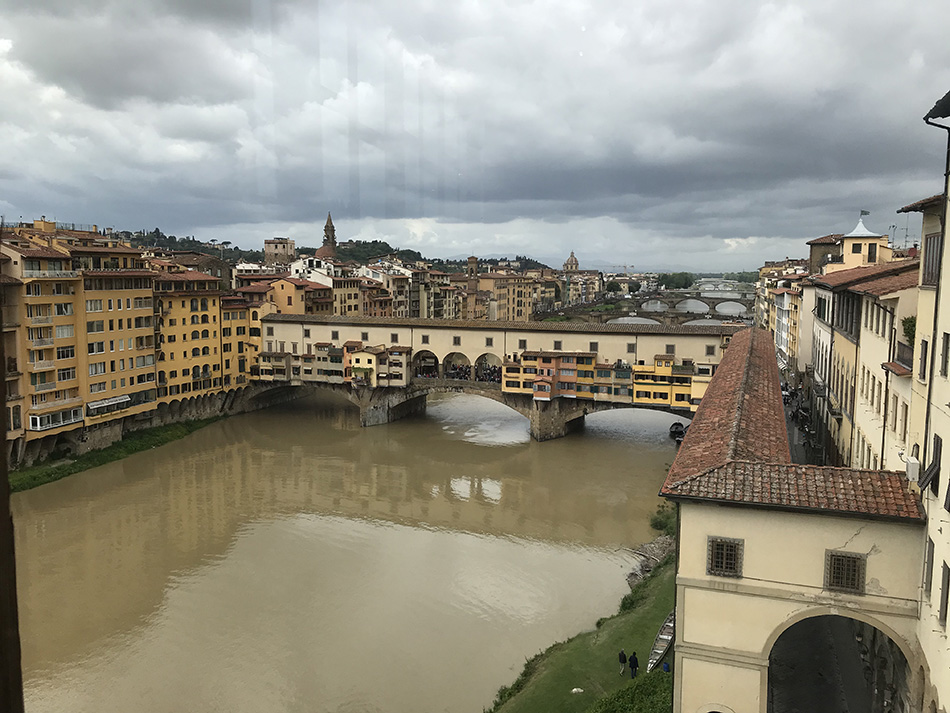
What a thrill to arrive in Florence for a 17-day visit. So much to see, so much to do! So I start with the Uffizi Gallery. Here is a view of the Ponte Vecchio spanning the Arno River as seen from the Uffizi. Click on any photo to enlarge.


The Uffizi is home to great sculpture and paintings of the ancient Greeks and Renaissance Italians. The Medici family collected and commissioned the items in the gallery.

Bacchus with grapes, Greek marble, 1st-2nd century CE, with 16th century restorations:


Giovanni Caccini (1556-1613), Hercules and Nessus. 
This piece has been in the same location since 1595:


Cupid and Psyche, unearthed in a garden on the slopes of the Celian Hill in Rome in 1666. The work, which can be dated to the second half of the 2nd century CE, is a Roman interpretation of a Hellenistic original developed in the late 2nd century BCE:


Paolo Uccello, The Battle of San Romano, ca. 1435-40:


One wing of the Gallery, lined with sculptures, and ceilings covered with elaborate paintings.


Sandro Botticelli, Spring (late 1470s or early 1480s):


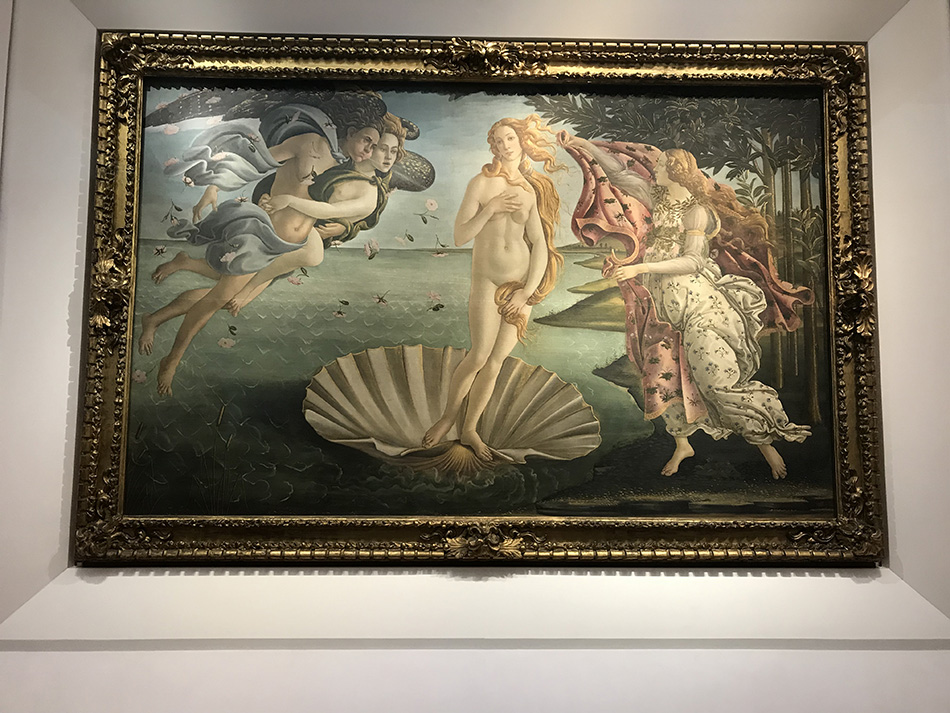
Botticelli, Birth of Venus (ca. 1485):


The Accademia Gallery is a smaller museum than the Uffizi and houses several sculptures by Michelangelo (1475-1564), including his David and many unfinished pieces.


Michelangelo Pietà


Michelangelo, Prisoner, unfinished work for the tomb of Pope Julius II


The Accademia contains a collection of historical musical instruments.
Here is a cello by Nicolò Amati from about 1650


Tenor viola 1690 by Antonio Stradivari:


By now, I am suffering from Stendhal Syndrome.

Marie-Henri Beyle (1783–1842), better known by his pen-name Stendhal, was a 19th-century French writer. Best known for the novels Le Rouge et le Noir (The Red and the Black) and others.

In 1817 Stendhal was reportedly overcome by the cultural richness of Florence he encountered when he first visited the Tuscan city. As he described in his book Naples and Florence: A Journey from Milan to Reggio:

As I emerged from the porch of Santa Croce, I was seized with a fierce palpitation of the heart (that same symptom which, in Berlin, is referred to as an attack of the nerves); the well-spring of life was dried up within me, and I walked in constant fear of falling to the ground.

The condition was diagnosed and named in 1979 by Italian psychiatrist Dr. Graziella Magherini, who had noticed similar psychosomatic conditions (racing heart beat, nausea and dizziness) amongst first-time visitors to the city.

In homage to Stendhal, Trenitalia named their overnight train service from Paris to Venice the Stendhal Express.

Click HERE for the next page on the Italian tour

Wednesday, July 3, 2019

Bomarzo, Park of Monsters

Bomarzo is a village of about 2,000 inhabitants about 50 miles north of Rome. Pier Francesco Orsini (1523-1583) was a condotierro, an Italian military leader. Following his capture and imprisonment in war, he retired to his family's estate in the province of Viterbo, turning away from war, politics and religion.
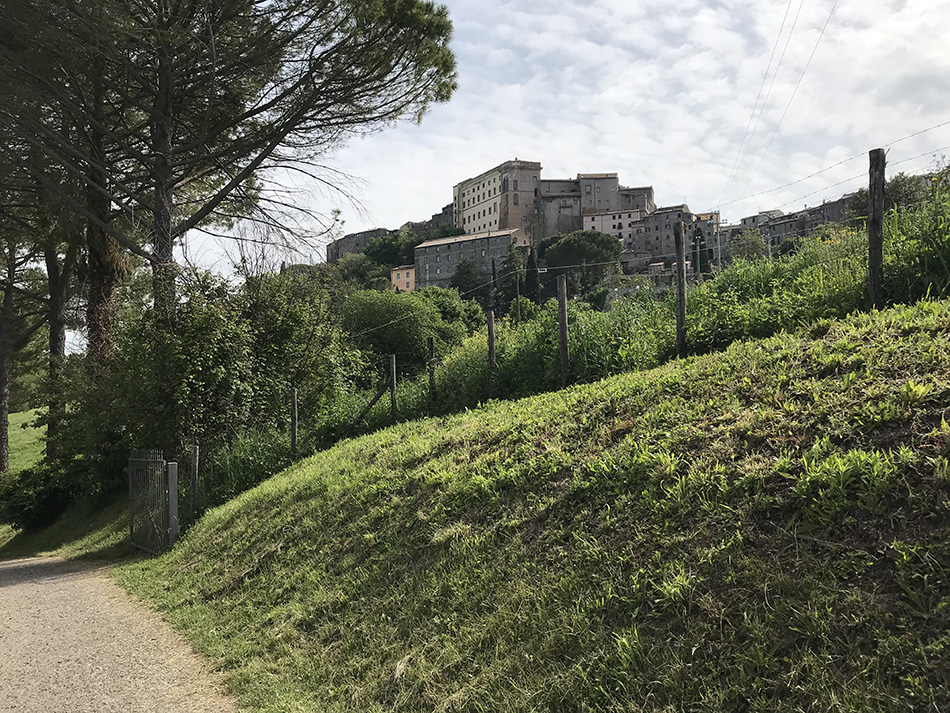
Here is a view of the medieval town of Bomarzo dominated by the palazzo:


And HERE is a link to my short video from atop the distant hill.

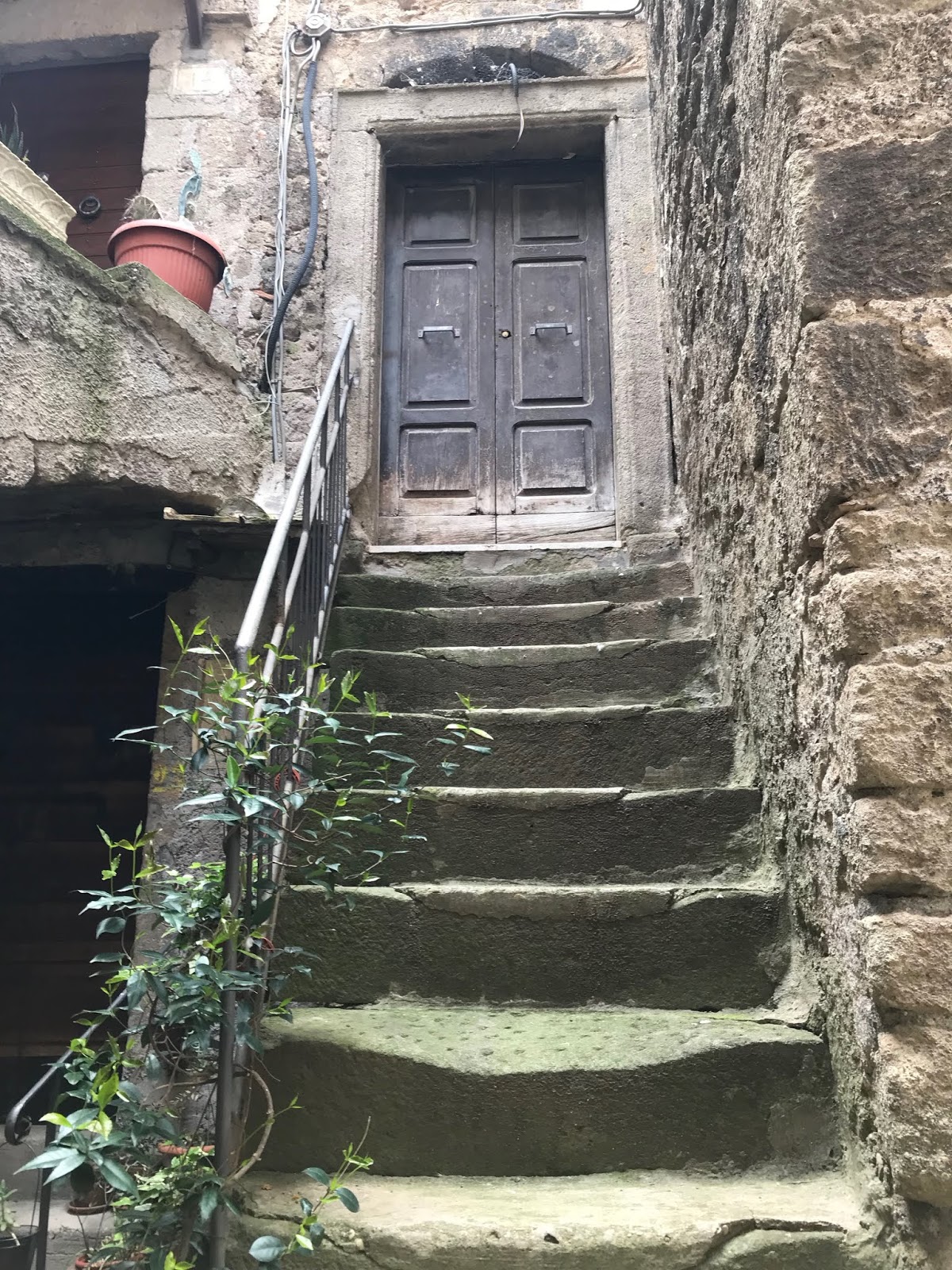
Views of the medieval town of Bomarzo:


In retirement, Pier Francesco Orsini devoted his time and efforts to art, creating the Sacred Grove, also called Park of Monsters. Carved out of the natural rock outcroppings, the mythical creatures are scattered about several acres of natural vegetation. The park is open to visitors.


One of Hannibal's elephants attacking a Roman centurion:


The Etruscan Bench

"You, who wander the world,
Anxious to see huge and magnificent marvels,
Come here where you will find hideous faces
Of elephants, lions, bears, ogres and dragons."


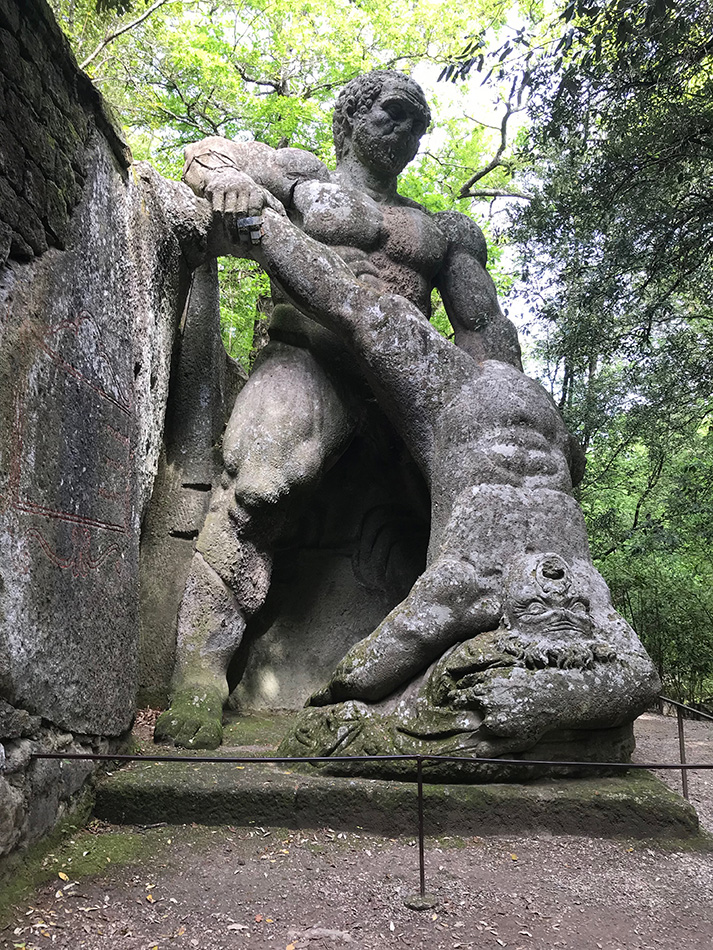
Hercules and Cacus:


The Ogre:


The Fury:


The Argentine writer Manuel Mujica Láinez published a novel in 1962 that creates a fictional story of Prince Orsini. The novel became the basis of the opera Bomarzo by Alberto Ginastera. I attended the 50th anniversary performance of the opera in Madrid in 2017. My review is HERE